Start With the Time You Actually Have
Before choosing exercises, before choosing days, answer one honest question: on an ordinary week — not a motivated week, not a holiday week — how many slots can you protect for training, and how long is each? Write that number down. It is the foundation of everything else in this guide, because a schedule is only useful if it survives contact with your real calendar.

Two well-placed sessions that happen every week will do more for you than five planned sessions that collapse by Wednesday. This is not lowering your standards; it is how training actually works. Adaptation comes from months of repetition, and repetition comes from a plan modest enough to keep. The American College of Sports Medicine's current position makes the same point: consistency and individualization matter more than chasing an idealized program you cannot sustain.
Guidelines Versus a Glute Schedule: Two Different Things
You will often see the CDC's physical activity guidelines for adults quoted in workout content: at least 150 minutes of moderate aerobic activity (or 75 minutes vigorous) per week, plus muscle-strengthening activity involving all major muscle groups on two or more days. That is public-health guidance for general health — a floor for the whole population. It is not a prescription for glute development, and a glute-focused schedule is not a substitute for it either.
The useful way to hold both ideas at once: build a week that covers the health basics — some strengthening for all major muscle groups and some aerobic activity you enjoy — and give your glute training a focused place inside that week. Your glute sessions are the spotlight, not the whole stage.
How Many Glute Sessions, and Where Do They Go?
There is no universally correct number of glute days. What the scheduling logic does tell you is how to place whatever number you choose: hard sessions for the same muscle group belong on nonconsecutive days, with at least one easier day between them, so the tissue you trained has time to recover before you ask it to work hard again. Two glute sessions might sit on Monday and Friday; three might sit on Monday, Wednesday and Saturday.
If you are newer to structured training, lighter resistance, or returning after a break, err toward fewer, well-spaced sessions and let the habit form before adding more. A beginner following light weights three times a week is not "behind" someone training five times — they are simply at a different point in the same process. Once your week is running smoothly, the progression guide shows how to add challenge inside each session.
A lighter week is also a legitimate choice in its own right, not a failed version of a harder one. Two short sessions with light resistance still teach the movement patterns, still build the habit of showing up, and still prepare the tissues for heavier work later. For many beginners a two-session week is a sensible introductory example to start from — one option among several, not the single correct week. Define your minimum week — the smallest version you would still count as training — and treat it as a real option rather than a consolation prize.
An Illustrative Two-Slot and Three-Slot Calendar
Here is how the logic above turns into an actual week. The worksheet diagram shows the three-slot version; the table compares both.
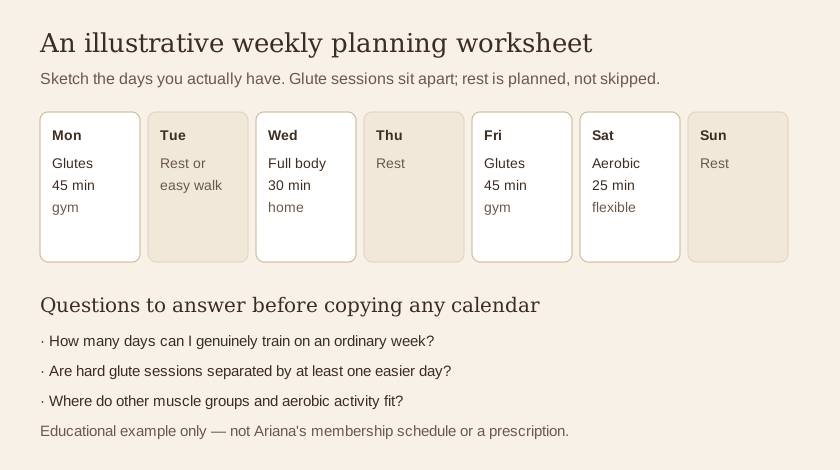
| Day | Two-slot week | Three-slot week |
|---|---|---|
| Monday | Glute session (45 min, gym) | Glute session (45 min, gym) |
| Tuesday | Rest or easy walk | Rest or easy walk |
| Wednesday | Aerobic activity you enjoy (30 min) | Full-body or upper-body session (30 min) |
| Thursday | Rest | Rest |
| Friday | Glute session (45 min, gym or home) | Glute session (45 min, gym or home) |
| Saturday | Optional light accessory work | Aerobic activity (25 min) |
| Sunday | Rest | Rest |
These calendars are illustrative examples of where strength sessions could sit — they are not a complete 150-minute weekly aerobic schedule, not Ariana's membership schedule, and not a prescription for any individual.
Notice the flexibility built into both. The glute sessions can move to Tuesday and Saturday if that fits your life better; what matters is the spacing, not the weekday names. The aerobic slot can be a walk, a bike ride or a dance class. The full-body slot can be a home session when the gym is not realistic — the gym equipment guide can help you decide which sessions genuinely need a gym. Rigid calendars break; structured-but-flexible ones bend.
Where Recovery, Aerobic Activity and Other Training Fit
Muscles adapt during recovery, not during the workout itself — the session is the signal, the rest is the response. That is why rest days appear in the calendar above as planned entries rather than empty space. If you finish the week feeling constantly drained, or your performance is sliding for several sessions in a row, the schedule is telling you something: reduce before you break. Readiness is day-level, too: poor sleep, an unusually stressful week, or lingering heaviness from the last session are all reasons to keep a planned session lighter — not reasons to abandon the week.
Be honest about what counts as recovery, though. An upper-body session asks little of the muscles recovering from glute work, but a full-body session can include hard lower-body training — squats, lunges, hinges — and that work counts toward your glute load and recovery for the week. If your full-body day trains legs hard, treat it like another lower-body session and space it accordingly rather than hiding it between glute days.
Aerobic activity is more flexible: a brisk walk on a rest day, a bike ride after an upper-body session, or a longer weekend outing all count. Whether a given aerobic session interferes with recovery depends on its duration and intensity and on your own recovery — an easy walk and a hard interval session are not the same input. Think of the week as a budget: hard glute sessions are the fixed costs, and everything else fills the remaining space without competing for the same recovery.
Planning Around Home and Gym Constraints
Decide the setting per day in advance, based on time and travel — not on willpower in the moment. A week that mixes settings works well when each day has a clear assignment: gym days for the sessions that use machines or heavier loading, home days for the rest. The home equipment guide can help you match home sessions to the equipment you actually have.
A membership that includes both settings makes this easier, because one weekly structure covers both gym and home routines — the setting decision becomes part of the plan rather than a daily dilemma.
What Should You Do When You Miss a Session?
Here is a concrete example. You planned glutes on Monday and Friday. Monday disappears under a work crisis. The tempting response is to "make up" the session by doubling Friday — two workouts crammed into one, or hard sessions on back-to-back days. Resist it. Stacking missed work trades one quiet week for several days of fatigue, and it teaches your brain that missing once makes training miserable. Instead, simply continue: train Friday as planned, and let Monday go. If misses become a pattern — three Mondays in a row — that is not a willpower problem, it is a scheduling problem. Move the session to a day that actually works. The plan serves you, not the other way round.
Some weeks are disrupted in advance — travel, deadlines, family commitments — and those deserve a plan too. The move is to shrink the week deliberately rather than let it collapse accidentally: decide which one session matters most, protect it, and release the rest without guilt. A planned one-session week keeps the habit and the identity ("someone who trains") intact, which makes the following week far easier to resume than a week that simply fell apart. Deliberate scaling is a scheduling skill, not a surrender.
Review the Calendar After Two Realistic Weeks
Give a new schedule two ordinary weeks, then review it with three questions: Did most planned sessions happen? Did I feel recovered between hard days? Did the plan survive my busiest day? If the answers are mostly yes, keep going — the schedule is working. If not, shrink the plan before you abandon it: drop one slot, shorten sessions, or move a day. A smaller schedule you keep is worth more than a bigger one you quit.
Here is what that review looks like in practice. Suppose you planned three slots — Monday gym, Wednesday home, Friday gym — and after two weeks you have completed four of six sessions. Both misses were Wednesdays, both because the evening disappeared. The wrong conclusion is "I need more discipline". The right one is "Wednesday is not a real slot". You move that session to Sunday morning, keep everything else, and run two more weeks. If the next review shows five or six of six, the schedule is now honest. If it shows four again, the plan is still too big — drop to two slots and rebuild. Each review should change exactly one thing, so you can tell what helped.
Notice what the review never asks: whether you felt motivated. Motivation is weather; the schedule is climate. You are checking whether the structure fits your life, not grading your enthusiasm. If building the week itself is the sticking point, the guide to following an online workout program covers how to make a structured plan part of your routine.
Before next week starts, answer these in a note on your phone:
- How many training slots do I genuinely have, and on which days?
- Are my hard glute sessions on nonconsecutive days?
- Where do other muscle groups and aerobic activity fit?
- Which setting — home or gym — does each session use?
- What is my rule for a missed session? (Continue, never catch up.)
- When will I review this plan? (After two realistic weeks.)
If your week mixes settings, Ariana's home program sits alongside the gym routines under one weekly structure, so a mixed week needs no improvisation.
The plan serves you, not the other way round.
If you would rather follow a schedule than build one, the Ariana M. Thompson membership includes a weekly structure for both gym and home routines, with group calls to talk through the weeks that do not go to plan.
Common Questions
How many days a week should I train glutes?
It depends on your experience, recovery and session design — there is no single right number. What matters most is that hard sessions for the same muscle group are spaced so you recover between them, and that the weekly total is one you can sustain for months.
What should I do if I miss a workout?
Simply continue with the next scheduled session. Do not stack missed workouts into one day as a punishment. One missed session changes nothing over a month; consistency across weeks is what counts.
Can I train glutes on consecutive days?
Light accessory work after a hard day is different from two demanding sessions back to back. As a general principle, give worked muscles recovery time before another hard session for the same muscle group.
How do I fit glute training around the rest of my exercise?
Give glute sessions their own nonconsecutive days, then place full-body or upper-body work and aerobic activity in the remaining space. Public-health guidelines also encourage muscle strengthening for all major muscle groups plus regular aerobic activity — a glute schedule should sit inside that bigger picture, not replace it.