Start With the Requirements of Your Routine
Equipment should follow your training plan, not the other way round. Before buying anything, open the routine you intend to follow and list what it actually uses. A bodyweight routine needs floor space and not much else. A band routine needs the bands it specifies. A dumbbell routine needs weights you can handle safely. Anything beyond that list is a purchase in search of a purpose. You can see how training is organized on the home workouts page — but treat general equipment examples as orientation, not a final shopping list.
This order of operations also protects your budget. The most common home-gym regret is not buying too little; it is buying a complete setup before the first workout, then discovering the routine uses a third of it.
Where Does Bodyweight Training Reach Its Limit?
Bodyweight glute work — bridges, hinges, single-leg variations — is a genuine starting point, not a watered-down version of "real" training. It teaches the movement patterns, asks nothing of your wallet, and can challenge a beginner for months. Its limit is progression: once you can complete high repetitions with control, making bodyweight work meaningfully harder gets awkward. You can slow the tempo, add pauses or move to single-leg versions, and all of those help — but eventually external resistance becomes the simpler path forward. That is the natural moment to consider bands or dumbbells, not before. The progression guide explains how to recognize that moment in your training log.
If a movement hurts — rather than simply feels hard — stop it and get qualified guidance rather than pushing through.
Short Loops, Long Bands and Safe Anchoring
Resistance bands come in two main styles for home glute work, and they are not interchangeable. Short loop bands (fabric or latex) sit around the thighs or hips for bridges, thrusts and abduction work; fabric versions tend to grip better and resist rolling, while latex versions are cheaper and come in finer tension steps. Long bands are for anchored movements and for adding tension to bodyweight exercises. If your routine uses both styles, both earn their place; if it uses one, buy one.
Two honest cautions. First, band colors are not standardized — one brand's "medium" is another brand's "heavy", so never convert a band color into kilograms or compare colors across brands. Second, anchor only where the manufacturer says to anchor. A band under tension attached to a table leg, a door handle or a DIY hook is a genuine hazard; use purpose-made anchor points and inspect bands for wear.
On effectiveness: a 2019 review of eight studies comparing elastic and conventional resistance found no superiority of one over the other for muscular strength. That is encouraging if bands suit your space and budget — though it compared strength, not identical glute growth or identical loads, so treat it as "bands are a legitimate tool" rather than "bands are identical to weights".
Bands are inexpensive, but they are also the one item of home equipment that degrades invisibly. Elastic fatigues with stretch, heat, sunlight and time, and a band that fails mid-rep can snap back painfully. Three habits cover most of the risk: store bands away from direct sun and heat, inspect them before each session for small tears, cracks or thinning spots, and replace them at the first sign of damage rather than stretching their life. Fabric loops last longer than bare latex but are not immune — check the stitching where the elastic is joined. A band is a consumable, and budgeting for an occasional replacement is part of owning one.
Dumbbells: Fixed, Adjustable, and Practical Increments
If your routine uses weights, the practical question is not "how heavy" but "how much room to grow". Fixed dumbbells are cheaper per pair and nearly indestructible, but progression means buying the next pair — and the jump between commonly available pairs can be larger than the small increases steady progression calls for. Adjustable dumbbells cost more upfront, replace several pairs, and usually offer finer increments; check the actual step sizes before buying, because some designs jump in awkward amounts. Whatever you choose, you want secure handling, clear floor space, and a storage spot where they will not become a tripping hazard.
Mats, Space and Household Reality
A mat is comfort and grip for floor work — straightforward. Supports deserve more care. If a routine calls for an elevated or bench-supported movement, use a stable platform rated for exercise: a proper exercise bench or step. Dining chairs, coffee tables, sofa edges and stacked objects are not rated for the loads a loaded movement puts through them, and "it felt fine last time" is not a safety rating. When the right support does not exist in your home, that is information — choose a routine variation that matches the equipment you actually have rather than improvising the furniture.
The unglamorous constraints decide more than the gear does. You need roughly a mat's worth of clear floor plus room to extend your limbs. Smooth hard floors need a mat with real grip for floor work; thick carpet makes balance and single-leg work less stable, so a firm mat on top often helps there too. Shared households mean equipment that packs away — bands in a drawer beat a bench in the hallway — and if you share walls or live above neighbours, favour controlled movements and set dumbbells down rather than dropping them. A setup that annoys the household will not survive long, and a budget spent slowly, adding one item when a routine genuinely calls for it, almost always beats a single large haul.
Do You Need Ankle Weights or a Home Machine?
Ankle weights are a modest, optional accessory: they add resistance to kickbacks, fire hydrants and standing abduction work where a dumbbell is awkward to hold. Useful if your routine includes those movements; easy to skip if it does not. Home machines — cable towers, hip thrust machines, abduction machines — sit at the other extreme: significant cost, significant floor space, and rarely required by home glute programs. If you are drawn to one, apply the decision table below with extra honesty at the "will I use it weekly" step, and compare what the same money does in a gym membership — the gym equipment guide covers what commercial machines offer.
What If You Split Training Between Home and the Gym?
Plenty of people train at home some days and at a gym on others, and that changes the buying logic. If your heaviest, most equipment-demanding sessions happen at the gym, your home setup only needs to cover the home sessions — which usually means bands, perhaps one pair of dumbbells, and a mat. There is no need to recreate the gym in your spare room. Decide which sessions live where first; the equipment list falls out of that decision almost by itself.
If scheduling across the two settings is the real bottleneck, the weekly schedule guide shows how to assign sessions to days before assigning them to rooms.
A Staged Buy, Borrow or Wait Decision
Many equipment questions answer themselves after two weeks of actual use, so borrow before you buy where you can. A friend's band set, a dumbbell pair from a family member, or a secondhand adjustable set from a local marketplace all let you learn what you will really use at very low cost. Secondhand dumbbells and benches are often excellent value — iron does not wear out in storage — while bands are worth buying new, because you cannot see the wear that matters in elastic. Whatever the source, apply the same safety checks: stable construction, no cracks or fraying, and rated for the use you have in mind.
Use this sequence for every potential purchase, in order. The diagram shows the same logic visually.
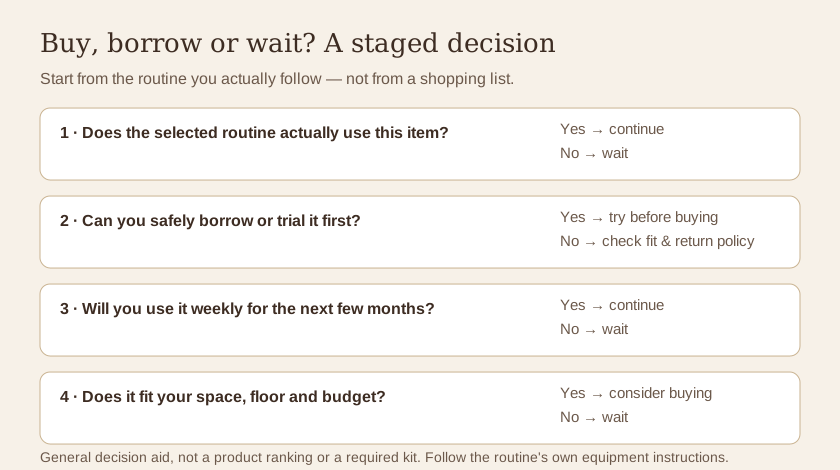
| Stage | Question | If yes | If no |
|---|---|---|---|
| 1 | Does the selected routine actually use this item? | Continue | Wait |
| 2 | Can you safely borrow or trial it first? | Try it before buying | Check fit and the return policy carefully |
| 3 | Will you use it weekly for the next few months? | Continue | Wait |
| 4 | Does it fit your space, floor and budget? | Consider buying, after the earlier checks | Wait |
A general decision aid — not a product ranking, price comparison or required kit. Follow your routine's own equipment instructions and each manufacturer's safety guidance.
Before any purchase, ask the seller (or yourself) three things: what exactly does my routine use this for, what are the real dimensions and increment sizes, and what is the return option if it does not suit my space? Vague answers are a reason to wait, not to buy.
Training at home with structure is exactly what the Ariana M. Thompson membership is built around — home routines with demonstrations, a weekly schedule, and group calls for your setup questions.
The most common home-gym regret is buying a complete setup before the first workout.
New to following a program online? The online program guide will help you settle in.
Common Questions
Can I train glutes at home with no equipment at all?
Bodyweight glute exercises exist, including glute bridges, and they are a legitimate starting point. Step-ups require a stable platform intended for exercise and are not an equipment-free option. Check the routine you follow — home training does not automatically mean no equipment, and bodyweight work has progression limits you will eventually meet.
Short loop bands or long resistance bands — which should I buy first?
They do different jobs. Short loops suit hip-focused work such as bridges, thrusts and abduction; long bands suit anchored movements and adding tension to bodyweight exercises. Buy the style your routine actually calls for, and only anchor a band to a point the manufacturer approves.
What dumbbell weights should I start with?
Rather than a fixed number, pick weights where you can complete your planned reps with good form and finish feeling you had one or two more in you. A pair you can grow into, or an adjustable set, gives you more room to progress than a single fixed pair — check the practical increment sizes before buying.
Are ankle weights worth buying?
They are a useful, low-cost addition for kickback and abduction-style movements where holding a dumbbell is awkward. They are optional, not mandatory, and they are not a substitute for heavier resistance in your main lifts.