Find the Schedule Before Anything Else
An online program has two things that matter on day one: the onboarding instructions and the current schedule. If the program provides a Start Here page or welcome material, read it fully — it usually answers the ten questions you were about to have. Then find the schedule and treat it as the program's home page. The schedule answers "what am I doing today?" without deliberation, and deliberation is where consistency slips.
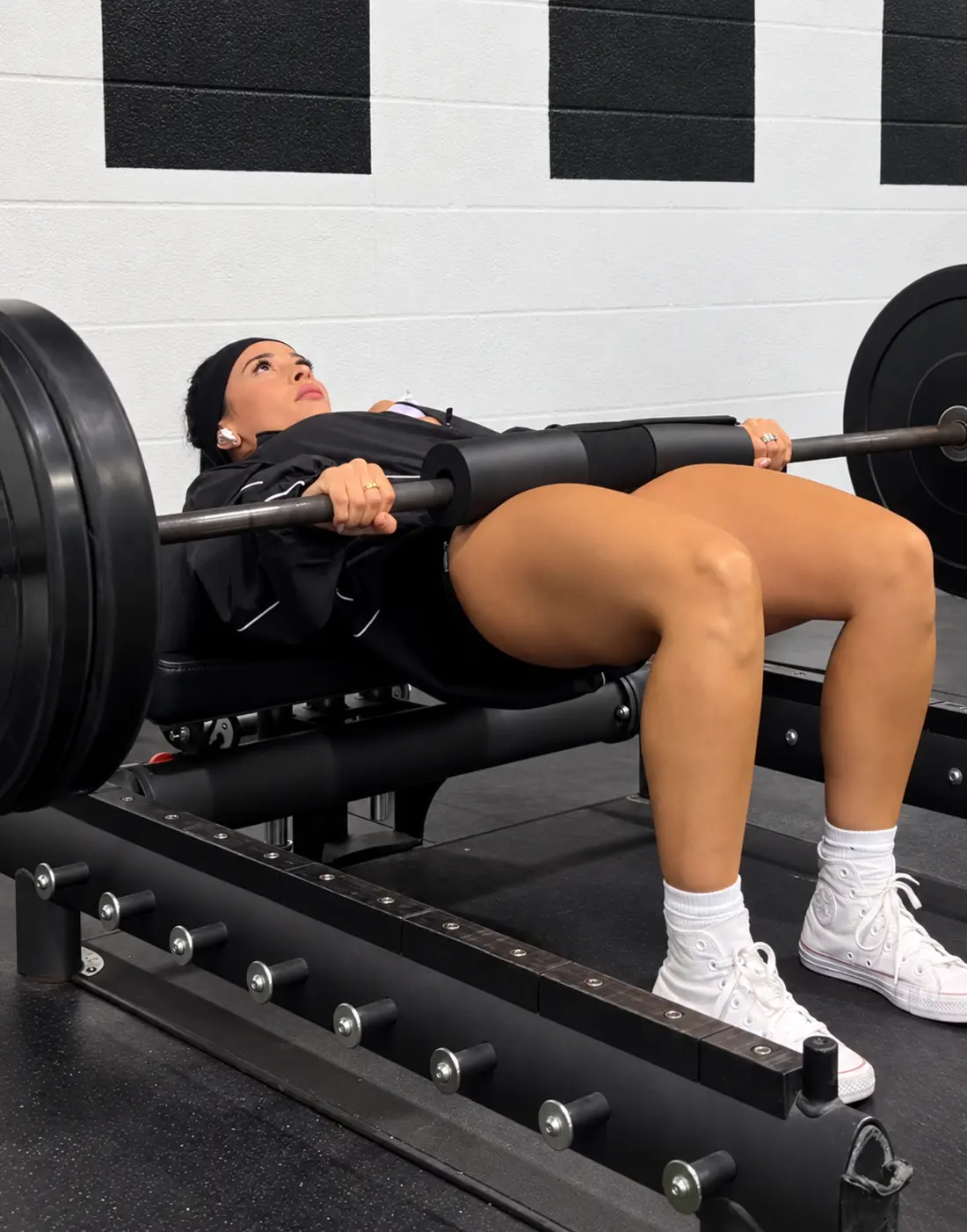
While you are there, note two practical details: what equipment the routines call for, and how the weeks are organized. Whatever program you follow, the home equipment guide can help you match its requirements to what you actually have.
How Should You Prepare Before a Session?
Ten minutes of preparation changes the whole session. Before you train: open today's workout, skim the exercise list, gather the equipment it needs, position your screen where you can see it mid-set, and watch the demonstrations for any movement you do not already know. That is it. Preparation is not about ritual — it is about removing the pauses where motivation leaks out: the hunt for a band, the scroll for a video, the "what was next again?"
Demonstration Videos Versus Follow-Along Videos
Programs generally offer two kinds of video, and confusing them wastes time. A demonstration is reference material: a short, clear explanation of one movement's setup and execution, meant to be watched when you need it. A follow-along video is a paced session you perform in real time. Use demonstrations like a dictionary — look up today's unfamiliar movements just before training, re-watch anything that felt uncertain afterwards. Watching the entire demonstration library before your first session feels productive and retains almost nothing.
When you re-watch, watch for the setup details rather than the highlight: where the support goes, what the start position is, what the controlled tempo looks like. Then reread the written instructions for reps and rest — the video shows the movement, the text governs the dose. If the setup involves equipment you have not used, the gym equipment guide explains what to check before loading it.
If a movement still feels wrong after two viewings, stop guessing at it. Note it, and ask. If a movement causes pain rather than effort, stop it and get qualified guidance.
Keep Notes Short Enough to Actually Keep
One running note on your phone is enough. Per session: what you did, how the last set felt, and anything you want to ask about. A single line per session, kept for months, beats an elaborate journal abandoned by week three. Those notes do two jobs: they show you the trend the progression guide describes, and they turn a vague "something feels off" into a question specific enough to answer.
Common First-Month Mistakes to Skip
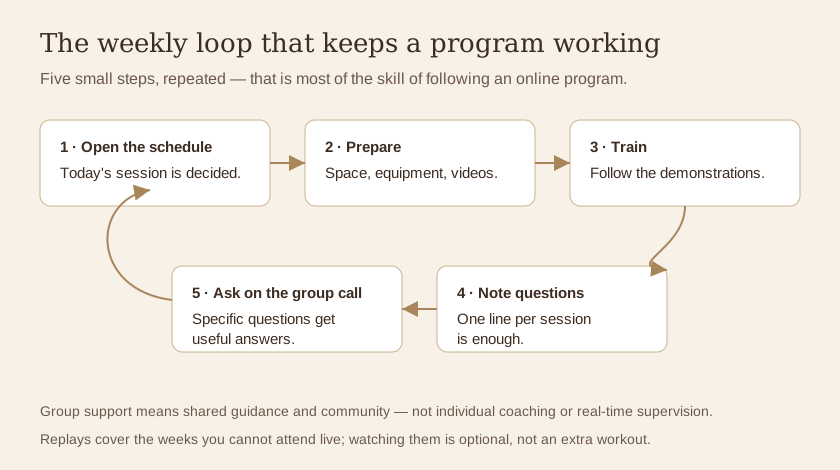
Three patterns derail new members often enough to name. First, sampling: trying a different workout every session instead of following one routine, which leaves you entertained but unmeasured. Second, front-loading: watching hours of content and buying equipment before the first session, which feels like commitment but postpones it. Third, silence: struggling with a movement for weeks without asking, when one specific question on a call would have resolved it. All three are understandable; all three are avoided by the same loop this guide describes — follow the schedule, prepare, train, note, ask.
Getting Real Value From Group Calls
Group calls are shared guidance: your coach addresses the group's questions, and everyone learns from everyone's situations. They are not one-to-one personal training, and nobody is supervising your living room in real time — expecting that sets the wrong bar. What group calls do exceptionally well is answer specific questions. "My hip thrust feels like it is in my quads at this weight — what should I check first?" gives a coach something to work with. "Any tips?" does not.
A little logistics goes far: confirm the call time in your time zone, join a couple of minutes early, and if you might have to drop off, submit your question in advance where the program allows. Come with one or two questions from your notes rather than a general request for motivation.
If you cannot attend live, replays cover most of the value — the answers survive recording. Watch replays when a topic matches your situation, at whatever time suits you, and skip the rest without guilt. A replay library is a resource, not a backlog: you do not "owe" the program hours of viewing, and catching up on recordings is not an extra workout. Members of Ariana's membership get replays of the weekly group calls for exactly this reason.
What Is Group Support — and What Is It Not?
It is worth being precise about the support model, because the wrong expectation is the fastest route to disappointment. Group support means a coach answers questions in a shared setting, discussions are recorded for replay, and a community of members keeps momentum between calls. It does not mean an individualized training plan written for you alone, real-time supervision of your sets, or a guaranteed private reply to every message. Used as intended, the group format is genuinely useful: you hear questions you had not thought to ask, and the answers apply to your training more often than you would expect.
The community works best when participation is concrete: specific questions, honest reports of what worked, encouragement that costs nothing and means something. Share at the level you are comfortable with — you never owe anyone your photos, your measurements or your personal circumstances, and anything posted in a group is visible to the whole group. Lurk first if you like; posting is a tool, not an obligation.
Your First Weeks, Concretely
- Read the onboarding or Start Here material all the way through
- Bookmark the weekly schedule
- Prepare for, then complete, the first session exactly as written
- Start a one-line-per-session training note
- Note the next group call in your calendar, in your time zone
- Write down one specific question to bring to it
- Introduce yourself in the community if you would like to
For a concrete example of the disrupted-week version: you complete Monday and Wednesday, then life takes the rest. Do not declare the week ruined and restart "properly" next Monday with doubled sessions. Simply do the next scheduled workout when you can, and let the unfinished days go. The weekly schedule guide goes deeper on building a week that survives real life.
Week one is about orientation; the weeks after are where the routine either takes hold or quietly dissolves. The difference is usually boring: the sessions stayed in the calendar at the same times, the preparation habit survived, and the training note kept getting its one line. If a week goes badly, do not restart from zero — reopen the schedule, do the next session, and treat the gap as information about which day or time did not work. By the end of the first month, aim to have completed most planned sessions, asked at least one question on a call or in the community, and built a note you can actually look back on. That is what following a program means in practice: not perfect adherence, but a working loop you return to after every disruption.
If you are considering a program rather than already in one, the home workouts page shows one of the two training settings included in the membership, along with how the routines are organized.
Following a program is not perfect adherence — it is a working loop you return to after every disruption.
The Ariana M. Thompson membership brings those routines together with the weekly group calls, replays and private community this guide describes.
Common Questions
Where do I start when everything is available at once?
Start with the onboarding or Start Here material if the program provides it, then open the current week's schedule. Ignore the rest of the library until you have completed a full week. Breadth is a distraction in week one.
Should I watch every demonstration video before my first session?
No. Watch the demonstrations for today's exercises just before you train, then re-watch any movement that felt uncertain afterwards. Watching everything up front is a lot of effort with very little retention.
What if I cannot attend the live group calls?
Use the replays to revisit the discussion at a time that suits you, and keep your questions for a future call or the community. Replays are a way to stay connected, not an extra workout you owe.
How do I ask a useful question on a group call?
Give the specifics: which exercise, what you tried, what happened, and what you want to change. 'My hip thrust feels like it is in my quads at this weight — what should I check?' gets a far more useful answer than 'any hip thrust tips?'.