Think in Movement Patterns, Not Machine Names
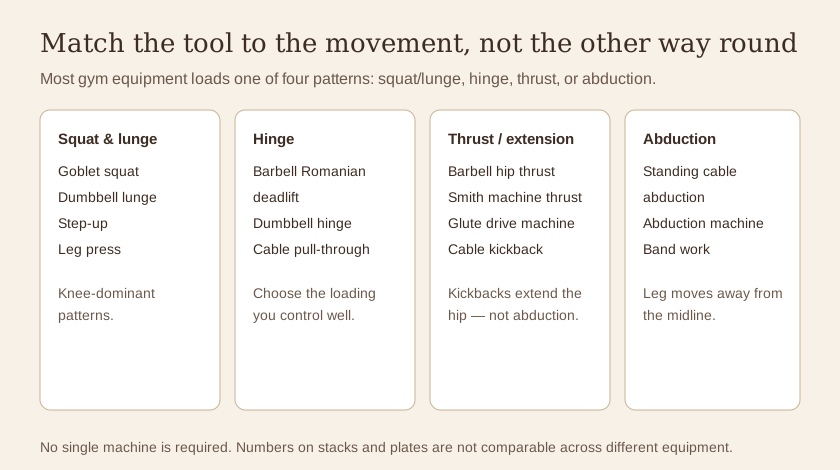
Gym equipment marketing wants you to memorize products. Training works better when you think in patterns instead. Most glute equipment loads one of four movements: a squat or lunge pattern (knee-dominant work such as squats, lunges and step-ups), a hinge (the Romanian deadlift family), a thrust or hip-extension pattern (hip thrusts, glute bridges and kickbacks, where the hips extend against resistance), and abduction (moving the leg away from the body's midline, as in standing cable abduction or the seated abduction machine). Kickbacks and abduction are often lumped together, but they are different movements: a kickback extends the hip, while abduction moves the leg sideways — worth knowing when a routine names one or the other.
Once you see the gym this way, every machine becomes an answer to a simple question: which pattern does this load, and how conveniently? The diagram below maps the common options onto the four patterns.
Free Weights: The Flexible Foundation
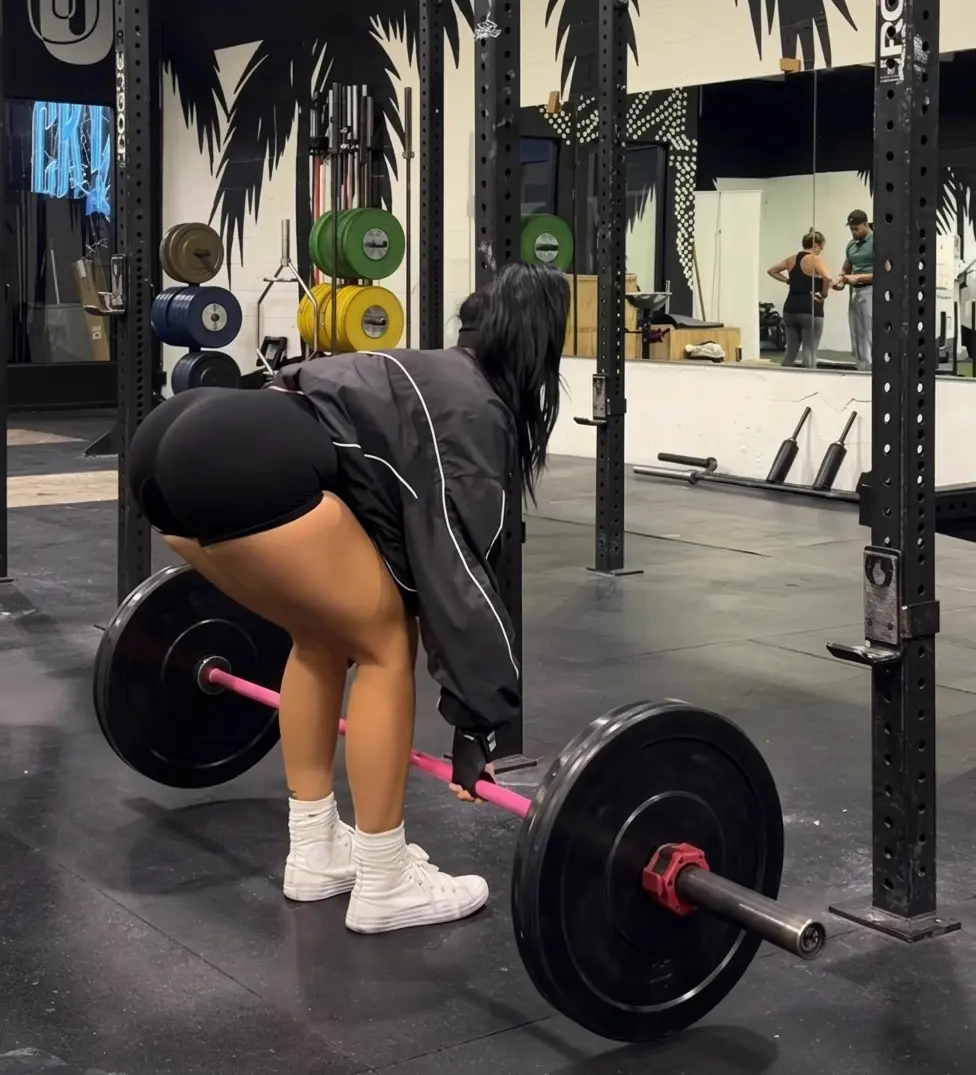
Barbells and dumbbells are the most widely available option and offer the finest progression steps — plates let you add load in small increments for years. A barbell hip thrust and a Romanian deadlift between them cover the thrust and hinge patterns, and dumbbells handle hinges, lunges, step-ups and lighter thrust work. The tradeoff is setup: positioning a barbell over your hips, loading plates and stabilizing the bar all take practice, and the first few sessions feel more like learning logistics than training. That learning curve is normal, and it flattens quickly.
Since the barbell is the most available tool, its setup is worth learning properly. For hip thrusts, the sequence that works for most people: position your upper back against a stable bench at a height that suits you, roll the loaded bar over your legs into the hip crease with padding in place, set your feet so your shins are roughly vertical at the top, and brace before the first rep. Take two or three light sessions to rehearse this before chasing weight. For hinges, the learning is in the hip movement rather than the equipment. If any of this feels uncertain, that is precisely what a demonstration video and a group-call question are for — and many gyms can walk you through a setup in person if you ask.
Guided Machines: Smith, Glute Drive, Cables and Abduction
A Smith machine guides the bar along a fixed path. For hip thrusts that means simpler setup, easier unracking and no need to balance the bar — which is why many people find Smith machine hip thrusts more comfortable than free-bar versions. The fixed path is also the limitation: it suits some body proportions better than others, so comfort is the deciding test, not dogma.
Glute drive machines are purpose-built hip thrust stations with their own pads, supports and loading systems — some use a selector pin, others are plate-loaded. For many people they make thrusts quicker to set up and more comfortable to load, but they are far from universal: not every gym has one. If yours does, learn its specific adjustments; if it does not, nothing is missing from your training. Check each model's instructions rather than assuming the machine in a demonstration is the machine in front of you.
Cable stations keep tension on the movement throughout the rep — though the resistance your muscles actually work against still varies with the angle of the pull — and they excel at kickbacks, pull-throughs and standing abduction work; the seated abduction machine covers similar territory from a fixed, simple position. These are supporting tools rather than the foundation of a program — valuable for rounding out a session, not a reason to choose or reject a gym. Note that cable stations are often the busiest equipment at peak hours, which matters more to your real training week than any feature list.
Machine Fit, Starting Load and Honest Numbers
Two practical checks apply to every machine you use. First, fit: seats, pads and supports adjust for a reason, and a machine set up for someone six inches taller will load the wrong places. If you are unsure, ask — many gyms will walk you through a machine's setup, though what is offered varies by facility. Second, loading: check that the machine's starting resistance suits you and that its increments let you progress in small steps, not jumps.
And a caution that saves confusion later: weight-stack numbers are not comparable across equipment. Each machine's levers, pulleys and cams change what the number means, so "60" on one abduction machine is not "60" on another, and neither tells you anything about a barbell. Track your progress within each setup — the progression guide explains how to log this properly.
A few gym-bag items come up often enough to mention, with the same framing as everything else here: optional. Footwear affects stability and the task, not just comfort — a flat, stable sole helps you feel the floor in hinge and thrust movements, while a soft running shoe can feel wobbly under load. A barbell pad or folded towel makes heavy thrusts more comfortable for many people. Lifting straps can help when grip limits a hinge before the target muscles do. None of these is required, none transforms a program, and all of them are "buy when a real annoyance appears" items rather than starter kit.
What Does the Evidence Say About Machines Versus Free Weights?
Honestly, and briefly. A 2023 review of resistance training equipment comparisons found that direct comparisons did not detect differences in muscle growth between equipment types, while strength improvements were partly specific to the equipment trained and tested on. Read that carefully: it does not prove every exercise is interchangeable, it was not women-only glute research, and it says nothing about which option you will enjoy or perform consistently. Consistency and progressive challenge drive results; the equipment is the delivery mechanism. Muscle activity readings or a strong pump during one machine session are not evidence of better long-term growth either.
How Should You Compare Gyms Before Joining?
Compare what a gym offers against the routine you intend to follow — at the time you will actually train. A gleaming machine row at 2pm on a Tuesday tells you nothing about 6pm on a weekday. Use this visit checklist:
- Visit at your real training hour, not a quiet showcase time
- Is there a stable, suitable bench or support if your routine uses bench-supported movements?
- Are the free weights, Smith machine or guided machines your routine calls for present and in working order?
- Is the dumbbell range deep enough where you will be working?
- Are the cable attachments you need available — and how busy is the station?
- Can you work without long queues at your hour?
- Are staff visibly available if you want help with machine setup?
Here is what that looks like in practice. Suppose you are choosing between two gyms. Gym A is cheaper and has every machine in this guide; Gym B costs more and has a smaller free-weight area, but it is on your route home. You visit both at 6pm on a weekday — your real training time. At Gym A, the two squat racks and the only Smith machine have queues, and the benches are all taken. At Gym B, the barbell area is busy but moving, and you could have started your session within five minutes. The checklist turns an abstract comparison into a concrete one: the "better equipped" gym is the one where you can actually do your routine at the hour you will actually be there. Equipment you cannot reach is decoration.
If you train some days at home as well, the home equipment guide covers the other half of that decision.
Busy Gyms: Planning Around Peak Hours
If your schedule has any flexibility, the single most effective equipment upgrade is a quieter training time. Mid-morning and early afternoon sessions in the same gym can feel like a different facility. When shifting your time is not possible, structure helps: do the movement that needs the scarcest equipment first, while you are fresh and the queue is shortest, and keep the parts of the session that need only open floor for later. The weekly schedule guide shows how to build that kind of structure into your week.
When equipment is busy or missing altogether, one-size substitution advice is not the answer — a different exercise is not automatically an equivalent one. Better questions to bring to a coach or a group call: "the hip thrust setup is taken for my whole session — which part of today's routine should I keep, and what can move to another day?" or "my gym lacks this machine — which routine option fits what I have?" Specific questions about your actual situation get useful answers; generic swaps often trade the movement's purpose for mere similarity. If a movement causes pain rather than effort, stop it and seek qualified guidance.
When two tools can load the same pattern, choose on practical grounds rather than theory: comfort, availability at your training hour, progression room, and how stable each setup feels at your working weight. Revisit the decision as these factors change — the right tool at week two is not always the right tool at month six. The online program guide has more on getting useful answers from a coach or group call.
Consistency and progressive challenge drive results; the equipment is only the delivery mechanism.
For how gym training works inside a structured plan, see the gym workouts page — it shows the gym side of the routines, demonstrations and weekly structure.
Whatever equipment your gym offers, the routine you can repeat at the hours you can train is the one that will work.
The Ariana M. Thompson membership includes both gym and home routines, demonstration videos and group calls where equipment questions like the ones above are exactly what you can bring.
Common Questions
Is a glute drive machine better than a barbell hip thrust?
Neither is universally better. A purpose-built machine is easier to set up, more comfortable and simpler to load, which often means more consistent training. A barbell is more widely available and adjusts in finer increments. Choose the option you can use consistently with good form.
Can I do hip thrusts on a Smith machine?
Yes — the fixed bar path makes setup and unracking simpler, and many people find Smith machine hip thrusts more comfortable than free-bar versions. The tradeoff is a fixed movement path that may or may not match your body's natural line.
What if my gym has no hip thrust setup at all?
A bench-supported movement needs a stable, suitable exercise bench and a setup that matches the routine. If that setup is unavailable, discuss an appropriate routine choice with a coach rather than assuming any flat bench or a different exercise is an equivalent substitute.
Are weight-stack numbers comparable between machines?
No. The number on a stack or plate reflects that machine's levers, pulleys and design — not a universal unit. Treat each machine as its own scale, track progress within it, and never compare stack numbers across different equipment.