What Progressive Overload Actually Means
Muscles adapt to the work you ask of them. For training to keep working, the challenge has to rise gradually over time — this is the principle usually called progressive overload. Two words in that sentence carry most of the weight. "Gradually" means small increases applied when you are ready, not bigger jumps applied whenever you feel eager. "Over time" means months of mostly ordinary weeks, not one heroic session.
Progression is also not only about heavier weight. Challenge can come from more repetitions, an extra set, a pause at the hardest point, a slower lowering phase, a single-leg variation, or simply better control through the full range of motion. The current American College of Sports Medicine position on resistance training emphasizes consistency and individualized progression rather than any single mandatory method — training to failure, for example, is an option, not a requirement.
Set Up a Repeatable Baseline Before Chasing Numbers
Numbers only mean something when the conditions behind them stay roughly the same. Before worrying about adding weight, make your setup repeatable: the same exercise variation, the same bench or band position, the same depth, the same rest between sets. A hip thrust performed with two inches less range than last week is not a stronger hip thrust — it is a different repetition.
Give yourself two or three weeks of simply performing your chosen routine consistently. That stretch becomes your baseline: the resistance and rep counts you can currently handle with steady form. Every later decision — add, hold, or back off — is judged against that baseline, so it is worth establishing honestly rather than optimistically.
You do not need an app or a complicated spreadsheet to keep that baseline. For each session, note the essentials:
- The date and which workout you completed
- Each exercise, the resistance used, and the reps per set
- How hard the final set felt — for example, "about two reps left"
- Anything notable: poor sleep, a rushed session, a movement that felt off
That last point matters more than it looks. A note saying "slept five hours, everything felt heavy" will stop you from misreading a flat session three weeks later, when the numbers alone would look like a mysterious loss of strength. If you are still deciding how your training days fit together, the guide to building a weekly glute schedule pairs naturally with this one — the log only works when the week around it is realistic.
How Do You Know When to Add Challenge?
Readiness is a pattern, not a feeling. Consider adding a small amount of challenge when, for two or three sessions in a row, all of the following are true:
- You complete every set with steady, controlled form
- The final reps feel challenging but not desperate
- You recover well enough that the next session starts fresh
If any of these is missing, hold steady. Repeating a week is not failure — it is consolidation, and it often precedes the next step forward. When you do add, change one variable at a time. If you add a set and slow the lowering and increase the resistance in the same week, you will never know which change did what — or which one to remove if it proves too much.
When the readiness signs are there, you have more options than "add weight". Each is a distinct tool rather than a rung on a fixed ladder from gentlest to heaviest:
- Add a repetition or two per set at the same resistance
- Add a pause at the point of greatest tension
- Slow the lowering phase — for example, three seconds down
- Add a set to one exercise
- Increase the resistance by the smallest step available
- Move to a harder variation, such as single-leg work
A slower lowering changes how the muscle works through the movement; an extra set changes how much total work you do; more resistance changes the load itself. Pick the one that fits why you are progressing — more control, more volume, or more load — rather than stacking all three because they all sound productive. More is not the goal; slightly more than before, sustained, is.
One simple way to structure increases is double progression: work within a rep range, and only add resistance when you reach the top of that range with good form. The diagram below walks through the idea with invented numbers.
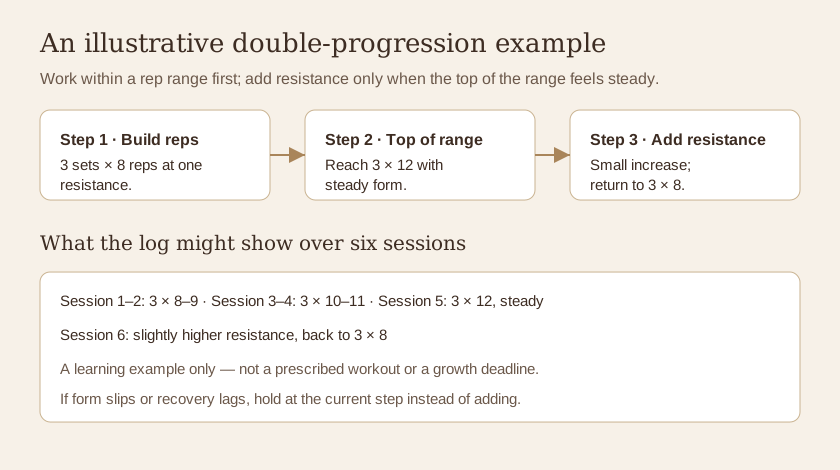
| Session | Resistance | Sets × reps | Decision for next time |
|---|---|---|---|
| 1–2 | Band + 10 kg dumbbell | 3 × 8–9 | Keep building reps |
| 3–4 | Band + 10 kg dumbbell | 3 × 10–11 | Keep building reps |
| 5 | Band + 10 kg dumbbell | 3 × 12, steady | Add a small amount of resistance |
| 6 | Band + 12.5 kg dumbbell | 3 × 8 | Rebuild toward 12 |
An illustrative example with invented numbers — not a prescribed workout or a deadline for progress.
Notice what the example does not say. It does not tell you to test your maximum, to train to failure, or to expect a size change by any date. It simply shows a calm loop: build reps, add a little resistance, build again. If you train in a gym, the gym training page shows how structured sessions there are organized inside the membership.
Home Bands Versus Gym Machines: Comparing Numbers Honestly
One of the most common tracking mistakes is comparing numbers across settings. A band-resisted hip thrust, a dumbbell hip thrust and a machine hip thrust all load the movement differently, and a "40" on one gym's weight stack is not the same resistance as "40" on another machine — let alone a band color, which has no standardized kilogram meaning at all. Band tension also rises as the band stretches, so the load at the top of the movement is not the load at the bottom. The home equipment guide explains what bands and dumbbells each change about the resistance you actually feel.
The practical fix is simple: compare like with like. Track your progress within one setup at a time, and treat a change of equipment as a new baseline rather than a jump forward or backward. A week that mixes settings is fine — just keep each setting's numbers in its own column of the log.
What Actually Counts as Progress?
Soreness feels like evidence, but it mostly measures novelty. A new exercise, a new rep range or a long layoff will produce soreness regardless of whether the session was well designed — and as you adapt, productive sessions often produce less soreness, not more. The same applies to the "pump", the temporary fullness during a workout: it reflects blood flow and fluid shifts within the session, not lasting change. Neither sensation belongs in your log as a scorecard. Record performance; let sensations be context.
When your hip thrust numbers climb over two months, several things improved: your technique, your coordination, your confidence under load, and the capacity of the muscles involved. Those are real wins. They are not, by themselves, proof that your glutes have changed in size — skill and strength gains can run well ahead of any visible change, and visible change has many inputs beyond one exercise's numbers. For how different equipment changes what the numbers mean, the gym equipment guide goes deeper; the short version is to track trends inside one setup and let the trend, not any single session, carry the verdict.
Why Progress Is Not a Straight Line
Sleep, stress, hormones, illness and ordinary life all affect what you can lift on a given day. A flat or dipping week is normal and expected; even a flat month happens. Progress over six months looks like a rising line with plenty of bumps in it, and the people who progress are not the ones who avoid the bumps — they are the ones who do not mistake a bump for a verdict.
This is also why the review rhythm matters: judge your training every four to six weeks against your log, not every session against your feelings. A single strong session proves little; a single weak one disproves nothing. The trend across several weeks is a far more honest scoreboard than either.
How Should You Review a Plateau?
When numbers stall, resist the urge to rewrite the whole plan. Work through this review in order:
- Consistency — how many planned sessions actually happened this month?
- Sleep and stress — has recovery changed, even if training has not?
- Setup — are you still performing the movement the same way as when the numbers rose?
- Effort — are the final sets genuinely challenging, or has "comfortable" crept in?
- Only then: the program itself — adjust one variable and give it several weeks
A plateau review like this is exactly the kind of specific situation that works well on a group call: "my hip thrust has been stuck at the same weight for five weeks, my sleep has been poor, and my setup changed when I switched benches — where would you look first?" is a question a coach can actually engage with. The guide to following an online program has more on turning notes into useful questions.
Judge the trend across the month, not the bumps in any single week.
Your Next-Session Progression Checklist
- I recorded my last session, including how the final set felt
- My setup today matches the setup I am comparing against
- I know whether I am adding, holding, or rebuilding — and why
- If I add, I am changing exactly one variable
- I have one specific question ready for the next group call if something felt off
Inside the Ariana M. Thompson membership, progression is built into the continuing programs — members receive structured plans and can discuss their progress on the weekly group calls. Whether or not you train with a membership, the loop is the same: repeat honestly, record briefly, add slowly, review calmly.
Common Questions
How often should I make my glute workouts harder?
There is no universal timetable. A practical rule: when you can complete your current sessions with steady form and finish each set feeling you could have done a little more, it is reasonable to add a small amount of challenge. Small, infrequent increases beat large, frequent ones.
Is soreness a sign that my glutes are growing?
Not reliably. Soreness mostly reflects novelty — new exercises or new volumes — not improvement or growth. Training-log trends in reps, resistance and control are far more useful indicators than how sore you feel the next day.
Should I track photos or measurements as well as my log?
You can, but treat them as long-term, rough context rather than weekly scorecards. Day-to-day changes in photos and measurements are mostly noise. Getting stronger or more skilled at an exercise is encouraging, but it is not by itself proof that your glutes have changed in size.
What should I do when my numbers stop improving?
Plateaus are normal. Before changing your plan, review sleep, missed sessions, setup consistency and effort — then adjust one training variable at a time. The membership's weekly group calls are a good place to talk a plateau through.